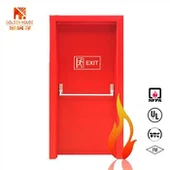
After identifying a fire-rated door, it is important to understand its label. Because this label communicates the exact specifications of a door’s fire rating (including what applications it is suitable for), it can act as a guide for repairs.
Traditional fire-rated door labels
Fire-rated door labels are attached to both the door panel and the door frame, usually on the hinge side of both. The information found on the label of a fire door includes: the testing agency, the door type and the amount of time (in hours or minutes) the door is expected to provide protection. Older doors may have a letter rating that corresponds to a time-based rating. An Authority Having Jurisdiction (AHJ) can help translate the letter rating system to minutes.
Fire-rated door labels also indicate the temperature-rise rating, which represents the expected surface temperature on the unexposed side of the door after 30 minutes of fire exposure. Finally, these doors can also include an S-label if a door is smoke rated. This “S,” often located in the center and near the bottom of the fire rating label, indicates the door has passed UL 1784: Standard for Air Leakage Tests of Door Assemblies and Other Opening Protectives.
The National Fire Protection Agency (NFPA) details the information on fire-rated door requirements in the NFPA 80 standards. To further clarify this information, an AHJ can help decode fire-rated labels.
Fire-rated glass labels
In addition to listing the independent testing agency, the product name and its basic characteristics, fire-rated glass labels also indicate which fire tests the glass has passed. These permanent labels communicate fire ratings with the following marks.
“W” for Walls: indicates fire-resistance-rated glazing meets Wall assembly criteria (ASTM E119 or UL 263)“OH” for Openings: indicates fire-rated glass meets fire window assembly criteria, including the hose stream test (NFPA 252 or UL9)“D” for Doors: indicates fire-rated glass meets fire door assembly criteria (NFPA 252, UL 10B or UL 10C)“H” indicates glazing meets the fire door assembly hose stream test—requirements for this test are location dependent, so confirm with an AHJ“T” indicates glazing meets 450-degree Fahrenheit temperature rise criteria for 30 minutesThe last component of the marking code is a two- or three-digit number. This number shows the fire rating of the fire resistance or fire protection glazing assembly in minutes (e.g., 45, 60, 90, 120). For example , if a fire-rated glass label reads “D-H-45,” one could determine the product is suitable for use within door assemblies, has passed the required hose stream test, does not meet temperature rise door criteria, and is fire-rated for 45 minutes. To further clarify fire-rated glass labels, TGP created this interactive tool that isolates and explains each mark.